Injection Molding Factory OEM vs Local Manufacturers: What’s the Difference?
Jul 20, 2026
As electronic devices become smaller, smarter, and more powerful, manufacturers face increasing pressure to produce components with tighter tolerances, lighter weight, and greater structural complexity. From wearable medical devices and AI hardware to automotive sensors and communication modules, miniaturized components are now at the center of product innovation.
Traditional manufacturing methods often struggle to meet these evolving requirements without sacrificing precision, production efficiency, or design flexibility. This is where metal nano molding technology has become an important manufacturing solution.
By combining ultra-high precision molding with advanced material processing, metal nano molding enables manufacturers to produce intricate metal parts that were previously difficult or expensive to manufacture. When integrated with CNC machining, thermal simulation, and engineering design, it provides an efficient path from product concept to mass production.

Metal nano molding is an advanced manufacturing process designed to produce highly precise metal components with extremely fine structural features. Unlike conventional machining, which removes material, nano molding forms metal into complex geometries using specially designed molds under carefully controlled conditions.
The process is particularly suitable for manufacturing:
Because the molding process minimizes material waste while maintaining excellent dimensional consistency, it has become increasingly attractive for high-volume manufacturing.
Nearly every major technology industry is pursuing smaller, lighter, and more integrated products.
Examples include:
Modern smartphones, smartwatches, earbuds, and AR devices require hundreds of precision metal components that fit within extremely limited internal spaces.
Electric vehicles and autonomous driving systems contain numerous sensors, cameras, radar modules, and control units that depend on compact metal structures capable of withstanding vibration and temperature changes.
Portable diagnostic equipment and minimally invasive medical devices demand precision metal parts with excellent reliability and repeatability.
Artificial intelligence servers, edge computing devices, and robotics increasingly require compact thermal management systems and precision mechanical components.
These applications all require manufacturing technologies capable of delivering micron-level precision without compromising production efficiency.
One of the greatest strengths of nano molding is its ability to create tiny features with remarkable consistency.
Manufacturers can produce:
Such precision is difficult to achieve consistently using traditional machining alone.
For industrial manufacturing, consistency is often just as important as precision.
Metal nano molding uses precision molds that enable identical parts to be produced across large production batches. This reduces assembly variation and improves overall product quality.
Since the process forms metal rather than removing large amounts of material, waste is significantly lower compared with conventional CNC machining.
This improves material utilization while supporting more sustainable manufacturing practices.
Once tooling has been optimized, nano molding enables rapid production of thousands or even millions of identical components with consistent quality.
This makes it suitable for consumer electronics and automotive supply chains where production volumes are high.
Although metal nano molding offers impressive capabilities, many high-performance components still require secondary machining.
CNC machining complements nano molding by providing:
The combination of both technologies provides manufacturers with greater flexibility while maintaining production efficiency.
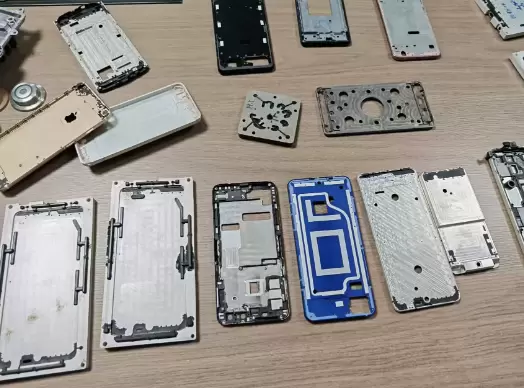
Precision shielding covers, structural frames, camera modules, connector shells, and internal brackets all benefit from nano molding technology.
Smaller components allow manufacturers to create thinner products while improving durability.
5G equipment, optical communication devices, and network infrastructure require highly precise metal parts that maintain performance under demanding environmental conditions.
Miniaturized RF shielding components and connector systems are common applications.
Modern vehicles contain increasing numbers of electronic modules.
Metal nano molding is used in:
These components require both mechanical strength and long-term dimensional stability.
Medical products require reliable manufacturing processes that produce repeatable, contamination-free components.
Typical applications include:
The excellent consistency of nano molding helps manufacturers meet strict quality requirements.
AI hardware often generates substantial heat while operating in compact spaces.
Nano molding enables manufacturers to create precision thermal structures and lightweight metal components that improve cooling efficiency without increasing product size.
Miniaturized electronics generate increasing levels of heat despite becoming physically smaller.
Without effective thermal management, excessive heat can reduce:
This is why thermal simulation has become an essential part of modern product development.
By evaluating airflow, heat distribution, and structural design before production begins, engineers can optimize component geometry and heat sink performance early in the design process.
Successful miniaturized products require much more than advanced manufacturing equipment.
They require close collaboration between industrial designers, structural engineers, mold designers, and manufacturing specialists.
An integrated development process generally includes:
Early engineering involvement often reduces redesign cycles and shortens product development timelines.
Producing miniature metal parts requires strict quality management throughout manufacturing.
Important inspection processes include:
Maintaining international quality standards helps ensure reliable production across different industries and applications.
Metal nano molding is a specialized manufacturing technology that depends heavily on engineering expertise.
Experienced engineers understand how material behavior, mold design, processing parameters, and machining techniques interact to influence final product quality.
Their knowledge helps reduce:
For companies developing highly customized products, engineering support is often as valuable as manufacturing capacity itself.
Manufacturers seeking reliable partners increasingly prefer suppliers capable of supporting projects throughout the entire product lifecycle rather than only providing production services.
SOGOOD offers one-stop manufacturing services covering:
Founded in Shenzhen, China's well-known design hub, SOGOOD combines industrial design excellence with advanced engineering capabilities. The company's experienced engineering team includes professionals with more than 20 years of expertise in metal nano molding and CNC precision machining. Many core engineers previously worked at BYD, bringing extensive practical experience in precision manufacturing.
SOGOOD serves customers across electronics, telecommunications, automotive, medical, and artificial intelligence industries. Supported by an ISO 9001-certified quality management system, the company provides reliable manufacturing solutions from prototype development to mass production.
For companies looking to learn more about SOGOOD's manufacturing capabilities, the following anchor link can be embedded in a website or article:
<a href="https://www.sogoodprecision.com/service/">metal nano molding and precision manufacturing services</a>
Several trends will continue driving adoption of metal nano molding:
As products continue shrinking while becoming more powerful, manufacturers will increasingly rely on advanced molding technologies capable of delivering both precision and production efficiency.
Metal nano molding has become a critical manufacturing technology for producing the miniature components required by today's most advanced industries. Its ability to create highly detailed metal parts with excellent repeatability, reduced material waste, and scalable production makes it an ideal solution for electronics, automotive, medical, telecommunications, and AI applications.
When combined with CNC precision machining, thermal simulation, and experienced engineering support, metal nano molding enables manufacturers to transform innovative product concepts into reliable, production-ready solutions. Companies that invest in integrated manufacturing capabilities are better positioned to accelerate product development, improve product quality, and remain competitive in rapidly evolving global markets.