Key Capabilities to Look for in an Industrial Plastic Injection Molding Factory
Apr 06, 2026
In modern product development, thermal performance is no longer an afterthought. As electronics become smaller, more powerful, and more integrated, heat management directly affects reliability, safety, and product lifespan. Engineers who fail to address thermal issues early often face expensive redesigns, delayed launches, and unexpected field failures.
Thermal simulation design services have emerged as a critical engineering tool to reduce these risks. By predicting heat behavior during the early design stage, companies can optimize product structures, select appropriate materials, and avoid costly trial-and-error prototyping.
For manufacturers and technology companies alike, thermal simulation is not just a technical upgrade—it is a strategic approach to reducing engineering costs while improving product performance.
Heat is one of the most common causes of product failure in modern devices. Whether it is a communication base station, an automotive control unit, or a medical device, excessive heat can damage components, degrade performance, and shorten product life.
Industries such as electronics, telecommunications, automotive, artificial intelligence, and medical equipment all face similar challenges:
Higher power density
Compact product structures
Increasing performance demands
Strict reliability requirements
Without proper thermal design, products may experience overheating, unstable operation, or reduced lifespan. Traditional development methods relied heavily on physical testing and multiple prototype iterations. While testing remains important, relying solely on physical prototypes significantly increases engineering costs.
Thermal simulation changes this process by allowing engineers to analyze heat transfer digitally before the first prototype is produced.
Thermal simulation uses computational modeling to analyze how heat moves through a product. Engineers can simulate conduction, convection, and radiation within complex structures and materials.
Typical simulation tasks include:
Heat source distribution analysis
Airflow and cooling path optimization
Material thermal conductivity evaluation
Heat sink performance analysis
Thermal stress prediction
Instead of building several physical prototypes, engineers can evaluate multiple design options within a virtual environment.
This significantly shortens development cycles while reducing material waste and engineering hours.
Companies that integrate simulation early in the design phase typically experience fewer late-stage design changes, which are often the most expensive part of product development.
One of the largest hidden costs in engineering is repeated redesign.
When thermal issues appear late in development, engineers may need to redesign key components such as enclosures, heat sinks, or circuit layouts. Each change can trigger additional tooling modifications, new prototypes, and extended validation tests.
Thermal simulation helps prevent these problems by identifying potential issues early.
Engineers can evaluate several variations of:
Fin structures in heat sinks
Airflow channel designs
Material thickness and conductivity
Component placement
With simulation, these changes can be tested quickly without manufacturing new hardware.
By reducing the number of physical prototypes required, companies can significantly lower development costs and accelerate time to market.
Heat sinks and thermal structures are essential components in high-performance electronics. However, designing them without simulation often leads to inefficient structures or oversized components.
Oversized heat sinks increase:
Material costs
Product weight
Machining time
Thermal simulation allows engineers to optimize heat sink geometry and airflow paths while maintaining effective cooling performance.
For example, engineers can analyze:
Fin height and spacing
Surface area efficiency
Airflow velocity distribution
Thermal resistance
By identifying the most efficient design, manufacturers can reduce material usage while maintaining optimal cooling capacity.
This balance between performance and manufacturability is critical for industries that rely on precision metal components and thermal management systems.
Reliability issues discovered after product release can become extremely expensive. Field failures often result in warranty claims, recalls, and damage to brand reputation.
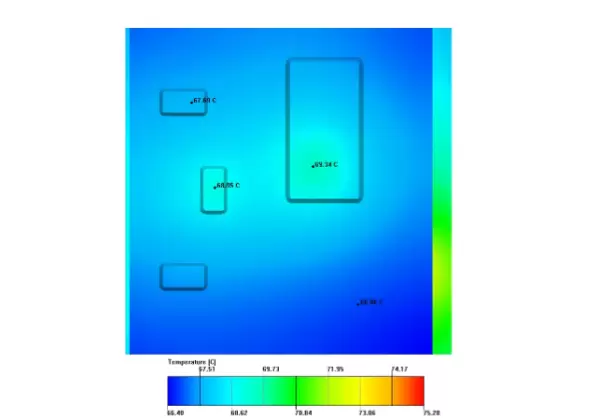
Thermal simulation allows engineers to identify potential hot spots and stress areas before the product reaches production.
By analyzing temperature distribution across the entire system, designers can ensure that sensitive components remain within safe operating limits.
This is especially important for industries such as:
Automotive electronics
Medical equipment
Communication infrastructure
Industrial control systems
Products in these sectors must operate reliably under demanding environmental conditions. Simulation provides engineers with valuable insight into how products behave in real-world scenarios.
Thermal simulation becomes even more valuable when combined with advanced manufacturing technologies such as precision CNC machining and metal nano forming.
These technologies allow manufacturers to create complex heat dissipation structures that would be difficult to design using traditional methods.
For companies looking for integrated engineering support, working with a manufacturing partner that offers both design and production expertise can significantly streamline development.
For example, manufacturers that provide integrated design, thermal simulation, and precision machining services can ensure that the simulated design can actually be produced efficiently.
This approach reduces the gap between engineering theory and real-world manufacturability.
<a href="https://www.sogoodprecision.com/service/">thermal simulation design services</a>
An effective thermal design process does not stop at simulation. The real value comes from translating digital analysis into reliable physical products.
SOGOOD is a company that provides one-stop manufacturing services covering product design, thermal simulation design, precision hardware, and heat dissipation solutions. The company focuses on developing and producing enclosures, accessories, auxiliary materials, and heat sinks for industries including electronics, telecommunications, automotive, medical equipment, and artificial intelligence.
Founded in Shenzhen, widely known as the “Design Capital” of China, the company combines engineering expertise with advanced manufacturing capabilities.
Its core technologies include:
Metal nano forming technology
CNC precision machining
Thermal simulation engineering
Structural design optimization
With experienced industrial designers, structural engineers, and mold engineers, the team has deep experience in industrial product innovation. Some of the core members previously participated in the design development of well-known Motorola models such as A1200 and A1600.
The company’s industrial designers have received international recognition, including the Red Dot Design Award. Over the years, the team has worked with global industry leaders including Qualcomm, ZTE, Lenovo, NEC, Han’s Laser, Philips, Panasonic, Haier, Midea, ASUS, and TCL.
Such experience allows the engineering team to approach thermal design from both a performance and manufacturing perspective.
Thermal solutions often rely on precisely machined metal components. Heat sinks, chassis structures, and thermal interfaces must be manufactured with high dimensional accuracy to perform as intended.
CNC machining is particularly suitable for producing complex thermal structures because it allows engineers to create detailed geometries with tight tolerances.
SOGOOD’s engineering team includes specialists with more than 20 years of experience in metal nano forming and CNC precision machining, many of whom gained extensive experience while working at BYD.
This background enables the team to bridge the gap between design simulation and real production.
Rather than designing theoretical structures that are difficult to manufacture, engineers can ensure that every thermal solution is optimized for both performance and production efficiency.
Thermal simulation reduces costs not only during development but throughout the product lifecycle.
Products designed with proper thermal management typically experience:
Fewer reliability failures
Lower maintenance costs
Longer service life
More stable performance
In high-volume industries, even a small reduction in failure rates can translate into substantial cost savings.
Additionally, optimized thermal structures often reduce material usage and manufacturing complexity, which lowers production costs over time.
When companies integrate simulation with advanced manufacturing capabilities, they create a more efficient development pipeline from concept to mass production.
Engineering reliability also depends on consistent manufacturing quality.
To ensure stable production results, modern manufacturers must follow internationally recognized quality management systems.
SOGOOD has implemented a modern quality management system aligned with international standards, and its products have passed ISO9001 certification.
This level of quality control ensures that thermal designs validated during simulation maintain their performance when produced at scale.
The company also supports both OEM and ODM cooperation models, allowing customers to choose from existing product solutions or develop fully customized engineering projects.
As electronic devices continue to become smaller and more powerful, thermal engineering will play an even larger role in product development.
Companies that rely solely on traditional design methods may struggle to keep up with modern performance demands and compressed development timelines.
Thermal simulation design services provide engineers with a practical and cost-effective way to solve complex heat management problems before they occur.
By integrating simulation, structural design, and advanced manufacturing technologies such as CNC precision machining and metal nano forming, manufacturers can deliver high-performance products with fewer development risks.
For technology companies aiming to bring innovative products to market faster while controlling engineering costs, thermal simulation is no longer optional—it is a core part of modern product design.