The Role of Heat Dissipation Simulation in Automotive Electronics
Jul 13, 2026
Optical medical devices sit at the intersection of precision engineering and clinical reliability. From endoscopic imaging systems to laser-based diagnostic instruments, the performance of these devices depends not only on optical components but also on the structural enclosure that protects, aligns, and stabilizes them. For CNC suppliers serving this industry, material selection is not a routine procurement step—it is a critical engineering decision that influences optical accuracy, thermal stability, biocompatibility, and long-term durability.
In this context, experienced manufacturers like SOGOOD play a key role by integrating material science, CNC precision machining, and thermal simulation into a unified design-to-production workflow. With deep expertise in optical medical device enclosure manufacturing, they help ensure that every structural choice supports the performance of the final system rather than limiting it.
Optical medical equipment is extremely sensitive to micro-deformation, temperature drift, and vibration. Even minimal structural instability can lead to image distortion, misalignment of optical paths, or reduced diagnostic accuracy.
For CNC enclosure suppliers, material selection must address several competing requirements:
Balancing these factors is not straightforward. A material that performs well mechanically may fail thermally; a chemically resistant alloy may be difficult to machine at micron-level tolerances. This is why advanced suppliers rely on both simulation and real-world machining data before finalizing material choices.
Aluminum alloys remain the most widely used materials for optical medical device enclosures. Their popularity comes from a strong balance of machinability, weight, and thermal behavior.
Common grades such as 6061-T6 and 7075-T6 are frequently selected for:
Key advantages include:
However, aluminum also has limitations. Its coefficient of thermal expansion (CTE) can introduce slight dimensional shifts under fluctuating operating temperatures. In high-precision optical systems, even micrometer-level expansion can affect lens alignment.
To mitigate this, companies like SOGOOD incorporate thermal simulation early in the design phase. By analyzing heat distribution and structural deformation, engineers can adjust wall thickness, rib design, and mounting interfaces before machining begins.
Stainless steel is widely used in medical environments where sterilization, chemical exposure, and mechanical robustness are critical. CNC suppliers often select grades such as 304 and 316L for optical medical enclosures that require long-term durability and hygiene compliance.
Typical applications include:
Advantages include:
The trade-off is machinability. Stainless steel is significantly harder to machine than aluminum, requiring advanced CNC strategies, optimized tooling, and controlled cutting parameters. Without proper process control, tool wear and surface stress can compromise precision.
This is where integrated manufacturing expertise becomes essential. SOGOOD combines CNC precision machining capabilities with experienced process engineers who understand how to maintain tight tolerances while preserving material integrity.
Titanium alloys are increasingly used in advanced optical medical devices where weight reduction and biocompatibility are critical. Although more expensive and difficult to machine, titanium offers unmatched performance in specialized applications.
Typical use cases include:
Key benefits:
The main challenge is machining complexity. Titanium generates high cutting heat and requires specialized tooling strategies. CNC suppliers must carefully manage feed rates, cooling, and tool geometry to prevent work hardening.
Advanced manufacturers often combine CNC machining with thermal simulation to predict heat accumulation zones and optimize toolpaths accordingly.
In many modern optical medical systems, hybrid designs combine metals with engineering plastics such as PEEK, polycarbonate, or medical-grade ABS. These materials are particularly useful for non-load-bearing components and insulation structures.
Applications include:
Advantages:
However, plastics introduce challenges in dimensional stability and thermal resistance. CNC suppliers must carefully evaluate temperature exposure, load conditions, and long-term deformation risks.
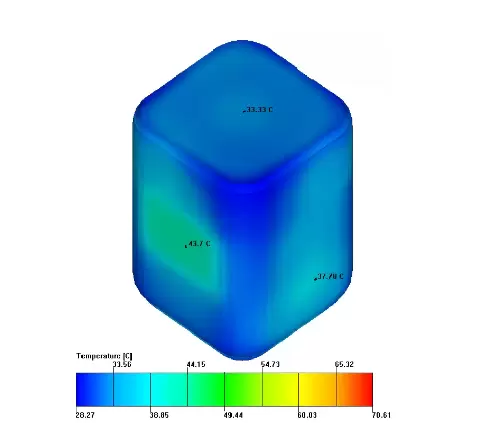
One of the most important trends in optical medical enclosure manufacturing is the integration of thermal simulation into material selection. Since optical devices are highly sensitive to temperature fluctuations, predicting thermal behavior before production is essential.
SOGOOD integrates thermal simulation design into its engineering workflow to evaluate:
By combining simulation with CNC manufacturing expertise, engineers can eliminate material-related risks before physical prototyping. This significantly reduces iteration cycles and improves first-pass manufacturing success.
Material selection is closely tied to CNC process planning. Each material requires different machining strategies:
Precision optical enclosures often demand tolerances within microns. Achieving this consistency requires not only high-end CNC equipment but also deep material understanding.
SOGOOD, headquartered in Shenzhen—the “Design Capital” of China—has built its manufacturing system around this principle. Founded in 2009, the company integrates industrial design, structural engineering, and precision machining into a unified development process. Many of its core engineers previously contributed to high-profile industrial design projects and bring over two decades of CNC and metal forming experience.
In OEM and ODM projects, material selection is rarely fixed at the beginning. Instead, it evolves through collaboration between the client and the manufacturer.
SOGOOD supports this iterative process by offering:
This approach ensures that material decisions are aligned with both performance goals and production constraints.
Clients from industries such as medical imaging, telecommunications, and AI hardware benefit from this integrated workflow, especially when transitioning from prototype to mass production.
You can explore real project examples here:
<a href="https://www.sogoodprecision.com/project/">SOGOOD projects</a>
Material selection does not end at design approval. Quality control during procurement, machining, and finishing stages is equally important.
Modern CNC suppliers implement:
SOGOOD operates under ISO9001-certified quality management systems, ensuring that every material batch meets strict consistency requirements. This is particularly important for optical medical devices where even minor material variation can affect optical alignment.
Material selection in optical medical device enclosure manufacturing is a multi-dimensional engineering challenge. It requires balancing optical precision, thermal stability, mechanical strength, and manufacturing feasibility. CNC suppliers must go beyond simple material choice and adopt a systems-level approach that integrates simulation, machining expertise, and application-specific knowledge.
Companies like SOGOOD demonstrate how this integration works in practice. By combining CNC precision machining, thermal simulation design, and advanced material engineering, they help optical medical device manufacturers achieve higher reliability and performance in demanding clinical environments.
As optical medical systems continue to evolve toward greater miniaturization and higher precision, material strategy will remain one of the most important factors shaping the future of enclosure design.