Key Applications of Industrial Thermal Management Solutions in Modern Manufacturing
Apr 03, 2026
Automotive electronics have evolved from simple control units into highly integrated, high-power computing systems that manage everything from engine performance and battery systems to autonomous driving and infotainment. As functionality increases, so does heat density. In this context, heat dissipation simulation has become a critical step in ensuring reliability, safety, and long-term stability of automotive electronic systems.
Modern vehicles rely on compact electronic modules operating under harsh conditions—vibration, temperature fluctuation, humidity, and confined installation spaces. Without proper thermal management, even the most advanced electronics can suffer from performance degradation, reduced lifespan, or unexpected failure. This is where heat dissipation simulation plays a decisive role.
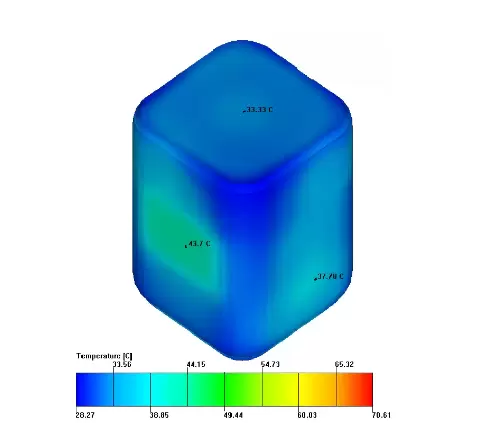
Heat dissipation simulation allows engineers to predict how heat flows through electronic components, enclosures, and surrounding environments before physical prototypes are built. In automotive electronics, this predictive capability is essential for several reasons.
First, power density continues to increase. Advanced driver-assistance systems (ADAS), electric powertrains, and onboard computing platforms generate significantly more heat than traditional automotive electronics. Without early-stage simulation, overheating risks are often discovered too late in the development cycle.
Second, automotive environments are highly constrained. Electronic control units (ECUs) are often placed in engine compartments or tightly sealed housings with limited airflow. Simulation helps engineers evaluate whether natural convection, forced air cooling, or conduction-based heat sinks are sufficient under real operating conditions.
Third, regulatory and safety requirements demand higher reliability standards. Thermal failure in automotive electronics can lead not only to system malfunction but also to safety risks. Simulation reduces uncertainty and ensures compliance with stringent automotive quality expectations.
Heat dissipation simulation typically involves a combination of computational fluid dynamics (CFD) and finite element analysis (FEA). These tools help model both heat transfer and structural behavior under thermal stress.
CFD is used to analyze airflow, convection patterns, and temperature distribution inside enclosures. It is particularly useful for evaluating cooling strategies such as ventilation paths or heat sink fin structures.
FEA focuses on solid-state heat conduction and material response. It helps engineers understand how different materials expand, deform, or accumulate heat under load.
When combined, these simulation techniques provide a comprehensive thermal profile of automotive electronic systems, enabling engineers to optimize both design and material selection before production begins.
In real-world automotive development, thermal simulation is not an isolated step but part of a broader engineering workflow. It directly influences mechanical design, material selection, and manufacturing strategy.
Companies specializing in precision engineering and thermal solutions play a key role in bridging simulation with production. One such example is SOGOOD, a company providing one-stop manufacturing services covering product design, thermal simulation design, precision hardware, and heat dissipation solutions for industries including automotive, electronics, telecommunications, medical devices, and artificial intelligence systems.
With strong expertise in CNC precision machining and advanced metal nano molding technology, SOGOOD integrates thermal simulation insights directly into the manufacturing process. This ensures that thermal performance is not just theoretical but physically validated through real-world production accuracy.
Their engineering team, based in Shenzhen, China, benefits from a deep industrial design heritage. The company was founded by experienced engineers with backgrounds in leading global technology projects, and its core team includes professionals who previously contributed to well-known mobile device designs. This combination of design creativity and manufacturing precision allows for efficient translation of simulation results into production-ready components.
More details about their engineering and service capabilities can be found here:
:contentReference[oaicite:0]{index=0}
Different automotive systems present unique thermal challenges.
In power control modules, high-current switching generates localized heat that must be dissipated quickly to prevent semiconductor degradation. In battery management systems for electric vehicles, maintaining uniform temperature distribution is critical for performance consistency and safety.
Infotainment systems and cockpit electronics, while less thermally extreme, require compact designs that limit airflow. This makes passive thermal management strategies, such as heat spreaders and conductive enclosures, especially important.
ADAS and autonomous driving modules combine high computational loads with real-time processing requirements. These systems often rely on high-performance processors that generate significant heat in confined spaces, making simulation essential for balancing performance and thermal safety.
One of the key advantages of modern engineering service providers is the integration of simulation with manufacturing.
A typical workflow begins with early-stage concept design, where thermal requirements are defined based on system power consumption and installation environment. Simulation engineers then model heat flow and identify potential hotspots.
Once thermal risks are identified, design iterations are made to optimize airflow channels, material selection, and structural geometry. At this stage, collaboration between thermal engineers and mechanical designers becomes crucial.
After validation through simulation, prototypes are produced using CNC precision machining or metal nano molding technologies. These methods allow for high accuracy in replicating simulation-based designs, ensuring that thermal performance in physical parts closely matches predicted results.
SOGOOD, established in 2009 in Shenzhen—known as China’s “Design Capital”—has built its reputation on this integrated approach. The company brings together industrial designers, structural engineers, and mold experts to support clients from concept development to mass production. Their expertise spans industries such as automotive electronics, communications, medical equipment, and AI hardware systems.
Their quality management system follows international standards, including ISO9001 certification, ensuring that every component meets strict reliability and consistency requirements.
Beyond technical optimization, heat dissipation simulation also delivers significant business value. By identifying thermal issues early, companies can reduce prototyping cycles, minimize redesign costs, and accelerate time-to-market.
It also enables more innovative product designs. Engineers are no longer constrained by trial-and-error testing; instead, they can explore compact, high-performance architectures with confidence that thermal behavior has been validated virtually.
For automotive manufacturers, this translates into more reliable electronic systems, improved vehicle safety, and better overall customer satisfaction.
Heat dissipation simulation has become an indispensable tool in the development of automotive electronics. As vehicles continue to integrate more advanced electronic systems, the ability to predict and manage thermal behavior is no longer optional—it is fundamental.
By combining simulation technologies with precision manufacturing and engineering expertise, companies like SOGOOD help bridge the gap between digital design and real-world performance. This integrated approach ensures that automotive electronics not only meet functional requirements but also maintain long-term reliability under demanding operating conditions.