Why Global Brands Choose a Power Bank Factory in China for OEM & ODM
Feb 16, 2026
High-power speakers are no longer limited to professional concert systems. From smart home audio to automotive infotainment and AI-enabled voice devices, modern speakers are expected to deliver louder output, richer bass, and consistent performance in increasingly compact designs. However, as power density rises, so does heat.
Thermal management has quietly become one of the most decisive factors in speaker reliability, sound quality, and lifespan. This is where thermal simulation plays a critical role—not as an optional optimization step, but as a foundational design tool.
When a speaker operates at high power, electrical energy is converted into mechanical motion—and inevitably, heat. The voice coil, magnet assembly, and surrounding structures are all exposed to thermal stress. Without proper management, this heat leads to several issues:
In real-world applications such as automotive dashboards or enclosed smart devices, heat dissipation becomes even more challenging due to limited airflow and compact enclosures.
Historically, speaker thermal design relied heavily on empirical testing and iterative prototyping. Engineers would build, test, adjust, and repeat. While this approach can eventually yield workable designs, it has clear limitations:
In today’s fast-paced product cycles, this approach is no longer sufficient.
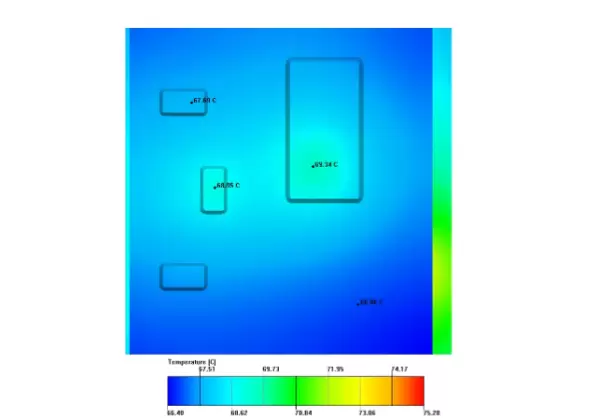
Thermal simulation allows engineers to model heat generation, transfer, and dissipation digitally before physical prototypes are built. This provides a deep understanding of how a speaker behaves under various conditions.
Simulation tools can identify where heat accumulates—whether in the voice coil, magnet gap, or enclosure walls. This insight enables targeted design improvements, such as:
Thermal effects directly influence acoustic performance. As temperature rises, the electrical resistance of the voice coil increases, altering frequency response and sensitivity.
By simulating thermal behavior, engineers can ensure that:
With accurate simulation, multiple design iterations can be tested virtually. This significantly reduces the need for physical prototypes and accelerates time-to-market.
Thermal fatigue is a major cause of speaker failure. Simulation helps predict long-term stress on materials and components, allowing engineers to design for durability from the start.
Thermal simulation is not just about identifying problems—it’s about enabling smarter design decisions across multiple dimensions.
The voice coil is the primary heat source. Simulation helps optimize:
Heat affects magnetic performance. Simulation ensures that:
The speaker enclosure plays a crucial role in heat dissipation. Engineers can test:
In modern devices, speakers are often integrated with amplifiers and other electronics. Thermal simulation helps manage the combined heat load and avoid hotspots within the system.
One of the biggest challenges in today’s speaker design is balancing compact form factors with high output requirements. Whether in smartphones, smart speakers, or automotive systems, space is limited.
Thermal simulation allows designers to:
Thermal design does not end at simulation. The effectiveness of a design depends heavily on how accurately it can be manufactured.
This is where advanced manufacturing technologies become essential.
SOGOOD, for example, integrates thermal simulation directly into its product development workflow. With expertise in metal nano-forming and CNC precision machining, the company ensures that thermal designs are not only theoretically sound but also manufacturable at scale.
Their approach includes:
This combination of simulation and manufacturing capability bridges the gap between design intent and real-world performance.
A key advantage of working with a one-stop manufacturing partner is the ability to connect different stages of development seamlessly.
At SOGOOD, thermal simulation is not an isolated step. It is integrated with:
This holistic approach ensures that thermal considerations are embedded throughout the product lifecycle—from concept to mass production.
For companies developing high-power speaker systems, this means fewer design iterations, reduced risk, and faster market entry.thermal simulation and precision manufacturing services
High-power speaker systems are used across multiple industries, each with unique thermal challenges.
Smart speakers and portable audio devices require compact designs with efficient heat dissipation to ensure user safety and product longevity.
In-car audio systems operate in high-temperature environments and must maintain consistent performance despite external heat and limited ventilation.
Speakers in communication devices must deliver clarity and reliability, often under continuous operation.
As AI-powered devices become more prevalent, speakers are expected to operate continuously, making thermal stability a critical requirement.
Skipping thermal simulation often leads to avoidable issues:
These problems not only affect product performance but also increase warranty costs and damage brand reputation.
As audio technology continues to evolve, the importance of thermal management will only grow. Trends such as higher power density, miniaturization, and integration with AI systems will push thermal limits further.
Thermal simulation will become a standard part of the design process, not just for high-end systems but for everyday consumer products.
Companies that invest in simulation-driven design and advanced manufacturing capabilities will be better positioned to deliver reliable, high-performance audio solutions.
Thermal simulation is no longer a luxury in high-power speaker design—it is a necessity. It enables engineers to predict performance, optimize designs, and ensure reliability in increasingly demanding applications.
When combined with advanced manufacturing expertise, such as metal nano-forming and CNC precision machining, thermal simulation becomes even more powerful. It transforms ideas into products that perform consistently in real-world conditions.
For businesses looking to stay competitive in the evolving audio market, integrating thermal simulation into the design process is not just a technical decision—it is a strategic one.