The Role of Automation in a Modern Industrial Plastic Injection Molding Factory
Jul 29, 2026
Speaker systems are often evaluated by their acoustic performance first, but thermal behavior can be just as important to long-term reliability. Professional speakers used for concerts, commercial installations, conference systems, and public venues may operate for many hours at high output levels. Automotive speakers face a different set of challenges, including limited installation space, temperature fluctuations, vibration, and the need to maintain consistent performance inside a compact vehicle interior.
As speaker designs become more powerful and increasingly compact, managing heat inside the enclosure has become a practical engineering issue rather than an optional design consideration. Thermal simulation can help engineers understand where heat accumulates, how it moves through the speaker structure, and whether the proposed housing and cooling design can maintain acceptable operating conditions.
For manufacturers developing speaker housings, heat dissipation components, brackets, and other precision metal parts, combining thermal simulation with structural design and manufacturing capabilities can shorten development cycles and reduce the need for repeated physical prototypes.
A loudspeaker converts electrical energy into acoustic energy, but not all electrical input becomes useful sound. A significant portion is converted into heat, particularly around the voice coil and magnetic assembly.
When a speaker operates continuously at high power, the voice coil can become hot. Excessive temperature may increase electrical resistance, change the behavior of the driver, reduce efficiency, and in severe cases cause permanent component damage.
The enclosure also plays an important role. If heat generated inside the speaker cannot be transferred efficiently to the surrounding environment, localized hot spots can develop. This problem can be more noticeable in compact professional speakers and automotive audio systems where internal space is limited.
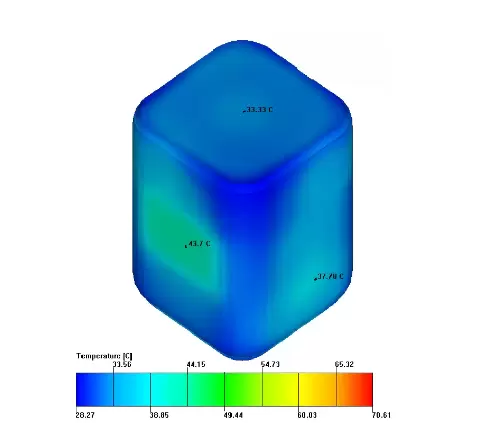
Thermal simulation allows engineers to examine these conditions before final tooling and production. Instead of relying entirely on physical testing, engineers can evaluate different materials, wall thicknesses, heat paths, ventilation structures, and thermal interfaces during the design stage.
Professional speaker systems are frequently required to deliver high sound output over extended periods. This creates demanding thermal conditions.
For example, a professional loudspeaker may contain a high-power driver, amplifier module, crossover components, and electronic control circuits within the same enclosure. Each component generates heat, and their combined thermal load needs to be considered.
Several areas deserve particular attention:
The enclosure material can significantly influence the overall thermal path. Aluminum and other conductive metals can transfer heat away from localized sources more efficiently than many conventional enclosure materials. However, simply selecting a highly conductive material does not guarantee good thermal performance.
The geometry of the housing, contact areas between components, mounting structures, ventilation openings, and surrounding conditions all affect heat dissipation.
This is where simulation becomes useful.
Automotive audio systems introduce another layer of complexity. A speaker installed in a vehicle door, dashboard, headrest, or other confined location may have very little room for natural heat dissipation.
Automotive components also experience a wide range of environmental conditions. Depending on the vehicle and application, the speaker may need to operate during cold starts, high cabin temperatures, direct solar exposure, and extended periods of continuous operation.
Thermal simulation can help engineers evaluate the interaction between the speaker assembly and its installation environment.
A simulation model may consider:
This information can be used to identify potential thermal bottlenecks early in development.
For example, if simulation shows that a particular area of an aluminum housing remains significantly hotter than the surrounding structure, engineers can investigate whether additional material thickness, improved contact with a heat-spreading component, modified rib geometry, or a different mounting structure would provide a better thermal path.
Thermal simulation is most useful when it is connected directly to the mechanical design process.
A common mistake is to treat thermal analysis as something performed after the housing has already been designed. By that point, changing the geometry may require new tooling or affect other components.
A better approach is to include thermal considerations during the structural design stage.
For example, engineers can compare several housing concepts before selecting the final design:
Design A: A conventional compact housing with limited heat transfer surfaces.
Design B: A housing with increased external surface area.
Design C: A housing with integrated heat-dissipation structures.
Design D: A housing optimized for both thermal performance and CNC manufacturing.
Simulation can compare the temperature distribution and heat transfer characteristics of these concepts under the same operating conditions. The results provide a technical basis for selecting the most suitable structure.
This approach can be particularly useful when the available installation space is fixed. Instead of simply making the enclosure larger, engineers can use simulation to determine where additional thermal capacity is actually needed.
Metal components can provide valuable thermal pathways in professional and automotive speaker systems. However, the manufacturing process must support the required geometry and dimensional accuracy.
CNC precision machining is suitable for producing speaker housings, mounting components, heat-dissipation structures, brackets, and other parts where dimensional control is important.
The relationship between simulation and manufacturing is important here. A theoretical thermal design is not enough if the proposed structure is difficult to manufacture or assemble.
For instance, a heat-dissipation feature may perform well in simulation but create unnecessary machining complexity. Engineers therefore need to balance:
A manufacturing-oriented simulation process can help identify practical solutions rather than optimizing a design only from a theoretical perspective.
For speaker components produced through molding or metal injection-related processes, manufacturability should also be considered during development.
Mold flow analysis can help evaluate filling behavior, potential defects, shrinkage, and other manufacturing-related issues. When thermal simulation and manufacturing analysis are considered together, engineers can make better decisions about geometry and material selection.
This is especially relevant for complex components where the thermal design includes ribs, thin walls, bosses, mounting points, or integrated heat-dissipation structures.
The objective is not simply to create a component that performs well in simulation. The objective is to create a component that can be manufactured consistently and integrated into the final speaker system.
Simulation does not eliminate physical testing. Instead, it helps make physical testing more focused.
After the initial design is evaluated through thermal analysis, engineers can build prototypes and compare actual temperature measurements with simulation results. If there is a difference, the simulation model can be adjusted based on real-world data.
This creates a practical development cycle:
Design → Thermal Simulation → Optimization → Prototype → Testing → Validation → Production
The earlier thermal problems are identified, the easier they are generally to address. A small change to enclosure geometry during the design stage is much easier to implement than a major structural modification after tooling and mass production have begun.
Speaker development often involves several disciplines at the same time. Acoustic requirements influence internal volume and component placement. Mechanical requirements determine the enclosure structure. Thermal requirements affect material selection and heat paths. Manufacturing requirements determine whether the final geometry can be produced reliably.
Working with an engineering partner that understands these relationships can make the development process more efficient.
SOGOOD provides integrated manufacturing and engineering services covering product design, thermal simulation, precision hardware, CNC machining, mold flow analysis, and thermal management solutions. Its capabilities support applications across electronics, communications, automotive, medical equipment, and artificial intelligence.
The company was established in 2009 and is headquartered in Shenzhen, China. Its engineering team includes experienced industrial designers, structural engineers, and mold engineers, with core members having backgrounds in major consumer electronics product development.
SOGOOD also has extensive experience in metal nano-molding technology and CNC precision machining. Its senior engineers have more than 20 years of experience in these areas, supporting customers that require both engineering development and manufacturing execution.
For companies developing speaker housings or other precision components, SOGOOD's integrated approach can connect simulation results with actual production requirements. More information about its engineering and manufacturing capabilities can be found through the following service page:
<a href="https://www.sogoodprecision.com/service/">thermal simulation and precision manufacturing services</a>
To obtain useful simulation results, engineers should provide accurate operating conditions whenever possible. Important inputs may include:
The quality of these inputs directly affects the usefulness of the simulation. A model based on unrealistic operating conditions may produce technically correct calculations but still fail to represent the actual application.
For this reason, thermal simulation should be treated as an engineering decision-making tool rather than simply a software output.
Thermal performance is becoming increasingly important as professional and automotive speaker systems become more compact and powerful. Excessive heat can affect component reliability, acoustic consistency, and service life, particularly when systems operate continuously in confined environments.
Thermal simulation provides engineers with a practical way to understand heat distribution, identify hot spots, compare enclosure concepts, and optimize heat-dissipation structures before committing to final production.
When simulation is combined with industrial design, CNC precision machining, metal forming technologies, mold flow analysis, and physical validation, it becomes much more valuable. The result is not only a better thermal design but also a more manufacturable and reliable product.
For speaker manufacturers and product developers, the most effective approach is to consider thermal management from the beginning of the product development process. With the right engineering and manufacturing support, thermal challenges can be addressed at the design stage and transformed into a more reliable final product.